Choosing a diamond can feel like it demands a vocabulary you do not have: four Cs, grading scales, letters and abbreviations. This guide explains the 4Cs of diamonds, cut, color, clarity and carat, in plain words. If you are short on time, start with our three qualities below. They are the only choice you actually have to make.
Start here: our three diamond qualities
Every KARAAT diamond is cut to an Excellent grade, the top grade and the biggest single factor in how a diamond sparkles. That never changes. What you choose is the color and the clarity.
[[karaat-qualities]]
All three are eye-clean: you will not spot an inclusion in any of them with the naked eye. Where they differ is whiteness, and what remains when you look through a loupe. We have deliberately chosen not to offer anything below Good.
The 4Cs at a glance
The 4Cs, cut, color, clarity and carat, are the common language for describing a diamond. The Gemological Institute of America (GIA) developed them in the 1950s, and they are now the industry standard. Lab-grown diamonds are graded on exactly the same scales as mined ones. Choose a quality to see where it sits on each scale.
[[karaat-4c-glance]]
Diamond cut: where the sparkle comes from
Cut describes how precisely a diamond's facets are angled and proportioned. It decides how much of the light entering the diamond is reflected back to your eye. That makes it the most important of the 4Cs, and the one most often overlooked.
[[karaat-cut]]
A well-cut diamond also looks larger face-up than a poorly cut diamond of the same carat weight. Cut is graded on five steps: Excellent, Very Good, Good, Fair and Poor. Every KARAAT diamond is Excellent.
Diamond color: the less, the better
Color grading measures how little color a diamond has. The scale runs from D, completely colorless, to Z, which has a visible yellow or brown tint. We work only with D to H. D–F is truly colorless and G–H near-colorless; the difference between them shows only side by side, in even light.
[[karaat-color]]
The diamond color scale in groups: D–F colorless, G–J near colorless, K–M faint, N–R very light and S–Z light yellow or brown.
Setting it in yellow gold? A diamond reflects whatever surrounds it, including its own setting. You will often read that yellow gold hides a lower color grade. Side by side in our showrooms we see the opposite: warm metal draws the yellow out of the diamond. If you want your diamond to stay bright and icy against gold, D–F holds its whiteness.
Diamond clarity: what you cannot see
Almost every diamond has tiny natural characteristics inside it or on its surface. Clarity grades how many there are and how visible they are under 10× magnification, from Flawless (FL) to Included (I3). We offer VVS and VS only. At these grades the characteristics can only be found by a trained gemologist with a loupe.
[[karaat-clarity]]
The diamond clarity scale from best to lowest: FL (flawless) and IF (internally flawless), VVS1 and VVS2 (very, very slightly included), VS1 and VS2 (very slightly included), SI1 and SI2 (slightly included), and I1 to I3 (included).
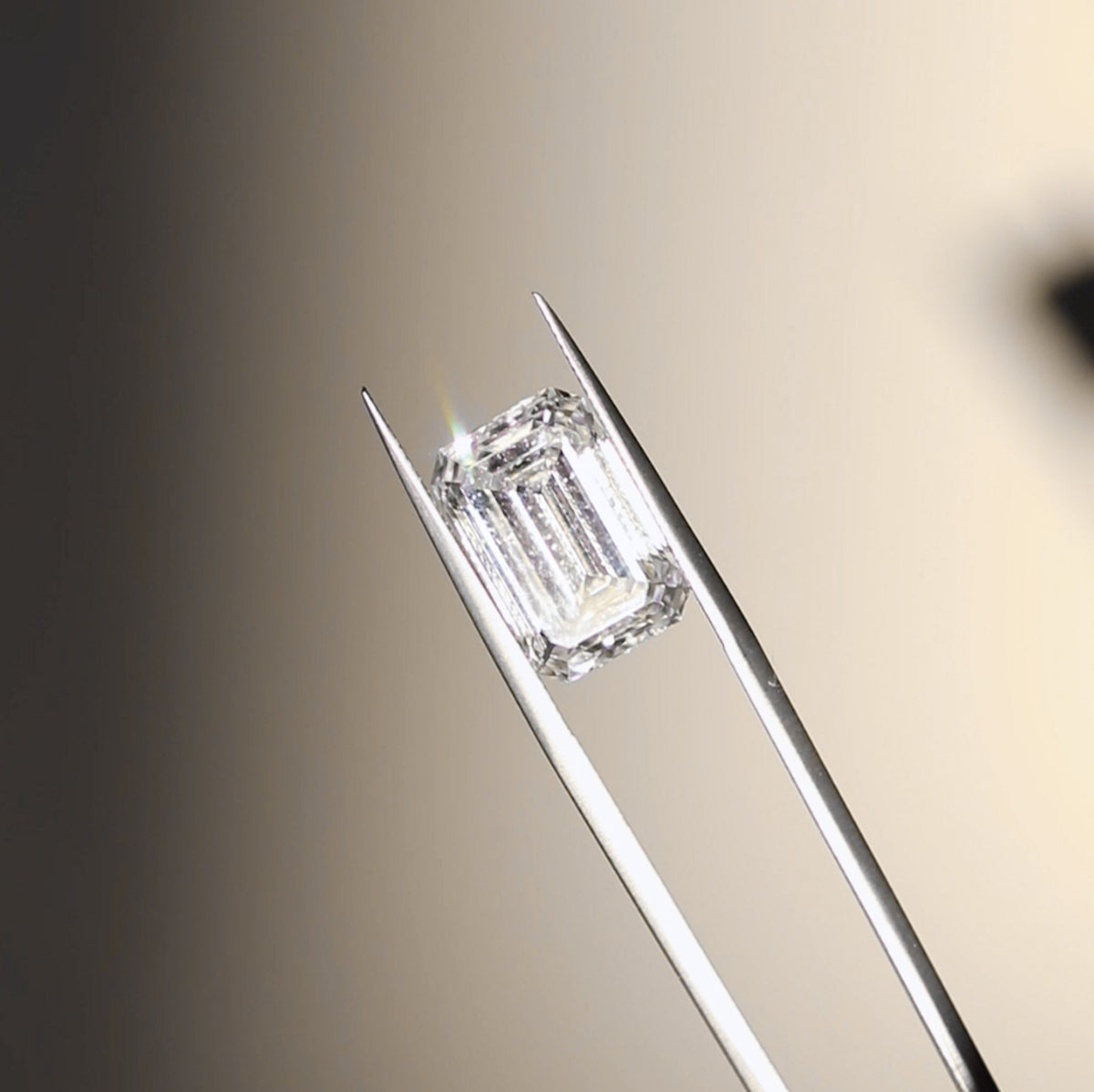
Drawn to an open cut? Emerald, asscher and other step cuts have long, clean facets that work like a window into the diamond. There is less sparkle to hide behind, so clarity carries more weight. VVS earns its place here.
Carat weight: not the same as size
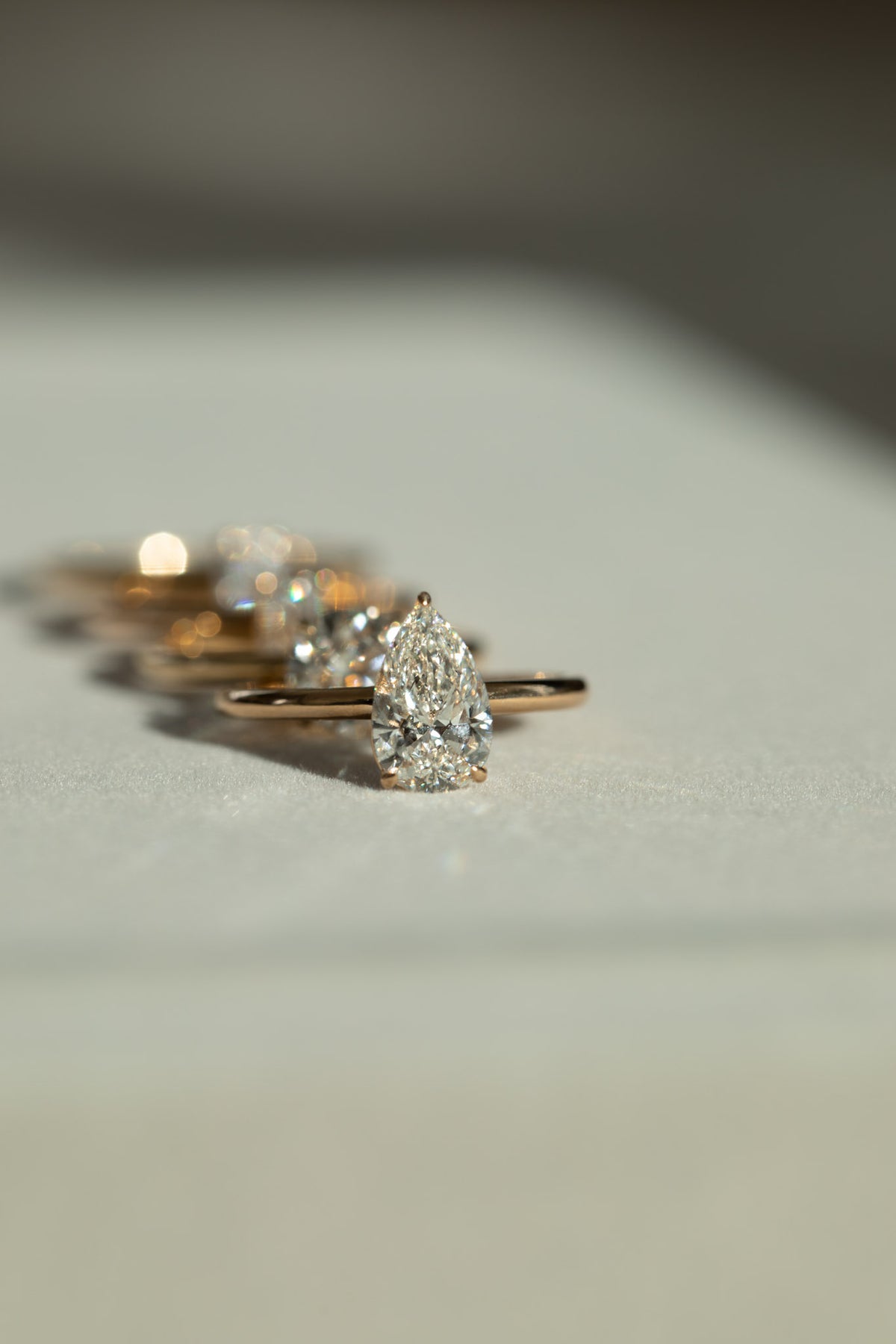
One carat equals 0.2 grams. Size grows with weight, but more slowly than you might expect: a 2 ct round diamond is about 25% wider than a 1 ct, not twice as wide. Shape matters too. Ovals, pears and marquises spread their weight over a longer outline and look larger face-up than a round diamond of the same weight.
[[karaat-carat]]
Our solitaires are available from 0.25 to 3.00 ct, in every quality.
Lab-grown, graded the same way
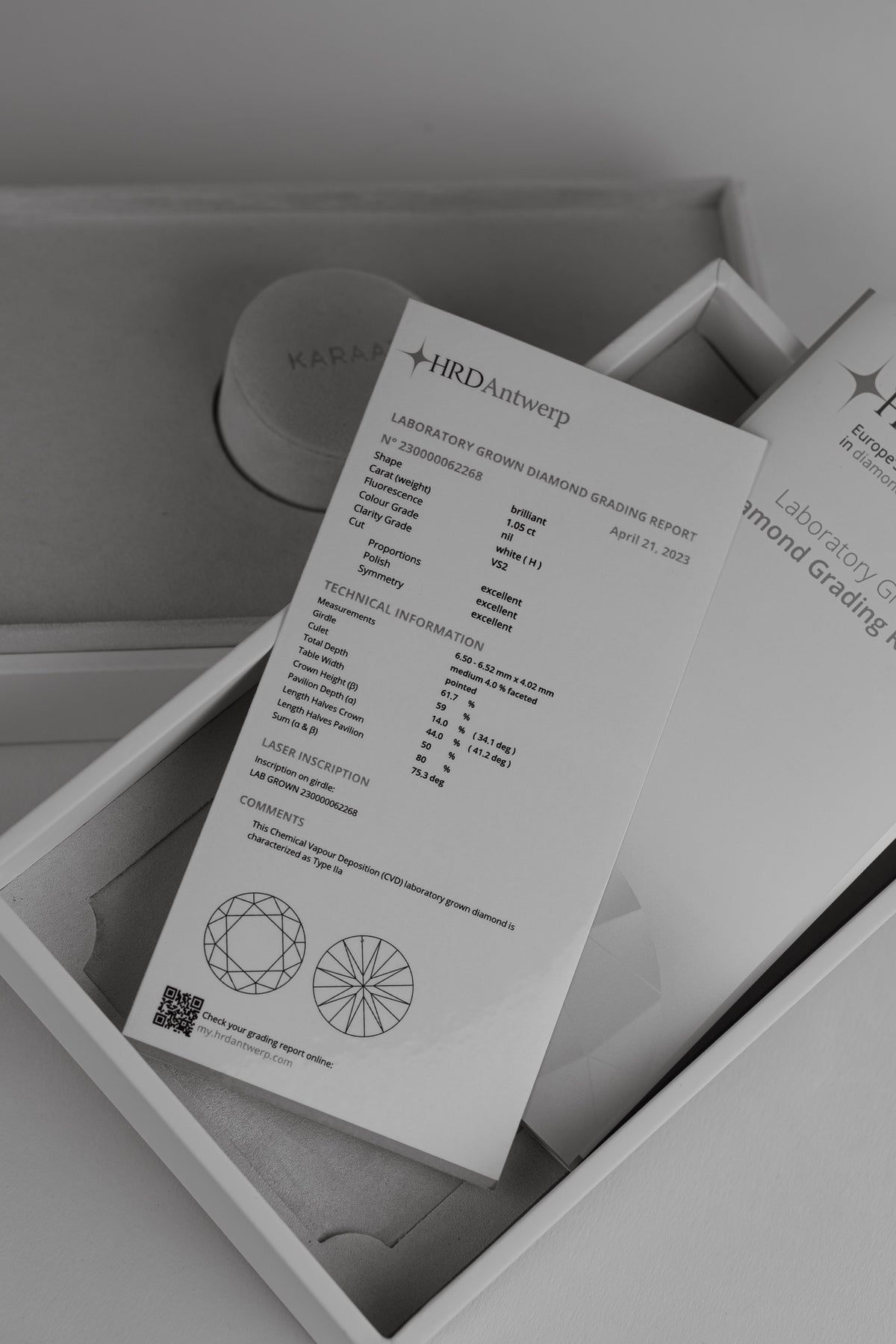
A lab-grown diamond is a real diamond: chemically, physically and optically the same as a mined one. It is graded on the same 4C scales by independent gemologists. Every KARAAT diamond from 0.50 ct comes with an HRD Antwerp certificate, and a microscopic laser inscription links the diamond to its report. Read more about lab-grown diamonds and diamond certificates.
See the difference in person
A screen cannot show you the difference between our three qualities. That is not a limitation of our photography; the differences live at 10× magnification and in subtleties of white that a camera flattens. Seeing the diamonds side by side settles the question in about a minute. When you visit, ask us to:
- Put all three qualities in front of you at the same carat weight, so the only thing changing is the grade.
- Show you each diamond through a loupe. This is where the clarity difference is actually visible.
- Set them against yellow, white and rose gold. Metal changes how white a diamond reads more than most people expect.
You can book a visit to our Helsinki or Stockholm showroom at any time. It is free, and there is no obligation to buy.
In short
- Cut decides the sparkle. Every KARAAT diamond is Excellent.
- Color runs from D, colorless, to Z. We offer D–H.
- Clarity measures natural inclusions. We offer VVS and VS, all eye-clean.
- Carat is weight. Cut and shape decide how large a diamond looks.
- Your choice is the quality: Excellent, High or Good.
Questions we are often asked
Which of the 4Cs matters most?
Cut, because it decides how much the diamond sparkles. That is why we only offer an Excellent cut and let you choose the color and clarity.
Can I see the difference between VS and VVS?
Not with the naked eye. Both are eye-clean. The difference shows under 10× magnification, and it matters most in step cuts such as the emerald cut.
Are lab-grown diamonds graded differently?
No. They are graded on the same 4C scales as mined diamonds, by independent gemologists.
Which quality do most customers choose?
High: D–F color and VS clarity. It is colorless to the eye and clean under a loupe.